
- Tuesday to Saturday: 10:30 – 16:30
Sunday: 10:30 – 15:30
Closed on Mondays


East History bookcase
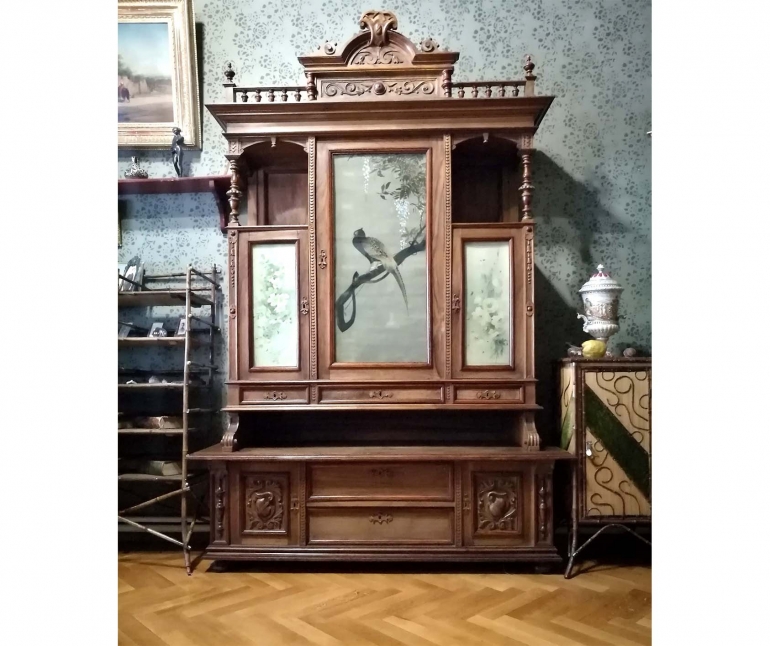
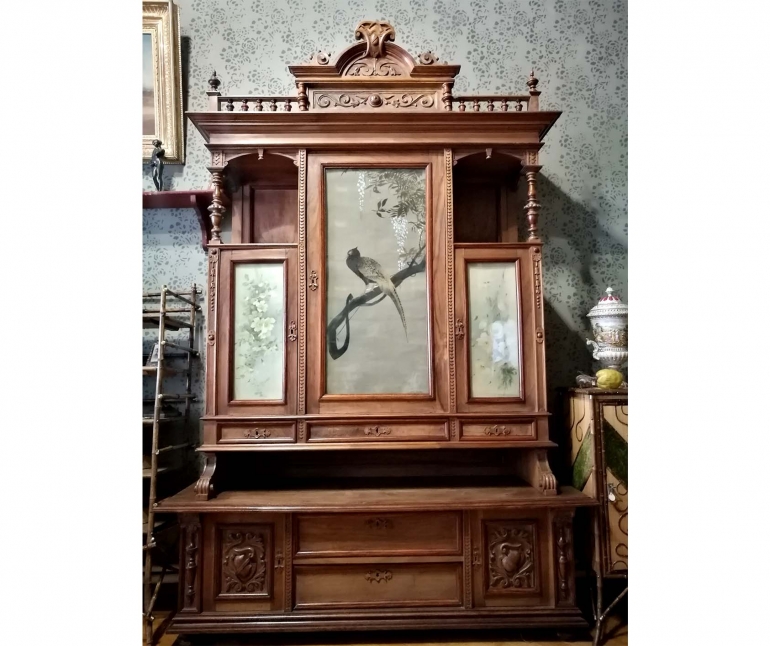
Hovhannes Toumanian, distributed his rich collection of books by their content in 13 thematic bookcases, using his bibliographic abilities. All bookcases stand out with their aesthetic solutions. The East history bookcase called "Ilya Muromets" stands out in particular. It is located in the poet's study. "... on the right wall ... there was a beautiful bookcase of the East history. We called that cabinet "Ilya Muromets" (Nv. Toumanian "Memories and Conversations"). Ashkhen Toumanian mentioned in her memoirs that it was "sold from a house". Toumanian took Ashkhen with him for support. "I couldn't help, I was afraid to praise the bookcase at home. He sat down and translated the "Ilya Muromets" bylina, he finished it in 2-3 days, took it to the editorial office, got money and bought the cupboard " (Ashkhen Toumanian: "Memories and Family Stories ").
Toumanian, being interested in folklore, highly assessed the Russian epic and paid special attention to its epic characters, which embody the best features of the Russian people. 1908 he translated "Ilya Muromtsi is fighting against Prince Vladimir" from V. Avenarius’ collection "Русские былины". He received 80 rubles for this translation and bought the bookcase (according to some sources, in 1908-1913 the average salary in Imperial Russia was 24 to 37 rubles a month, higher salary was 50 to 80 rubles, and sometimes, depending on the profession, it could reach up to 150 rubles. In the first half of the 19th century, 1 dollar was equivalent to 1.94 rubles, so 80 rubles was equivalent to 41 dollars).
During the last years of his life, Toumanian studied the history of the ancient nations of the East, their philosophy, literature and folklore, and translated a number of Eastern writers.
"We are from the East, but we do not know the East. "We do not know our neighbors at all; we do not know their literature."
Thus, in the rich repository of his books, one by one were added books related to that topic: Indian and Chinese history, Japanese culture, Indian Vedas, studies on yoga, works by Persian and Arabic writers, a large number of translations of works by R. Tagore and Saadi, Khaqani and Omar Khayyam, as well as many Arabic, Indian, Japanese and Chinese tales.
The cabinet – made of walnut wood – has a complex structure, corresponding to the style of classicism. It has two floors, consisting of lower and upper parts. The upper bouts featured two cutaways, for easier access to the higher frets. The central leaf is wide-large, the lateral ones are narrow-small. All three shutters are glazed, the latter covered with wallpaper. The wallpaper covering the glass of the middle door that stretches to the cornice depicts a parrot sitting on a branch, and the two small doors next to it are decorated with white rosemary flowers. On the vertical edges of the leaves are canopy-shaped trunks decorated with geometric (flat-shaped) carved patterns.
At the top of the small doors there are double-sided grooves that extend to the cornice, the front and outer side walls of which are open, with one corner pillar, decorated with carved sockets of different sizes, joining the cornice.
The forehead rises on the protruding cornice. In the central part it consists of two parts. The lower rectangular section is decorated with carved floral ornaments, the upper part ends with an arched carved section, the top of which crowns the resulting shield-like detail. On both sides of the central part of the jacket, the cornice (each consisting of five ornaments) stretches from the cornice to the corners, ending in square protruding columns, crowned with conical ornaments. There are three movable shelves inside the doors. There are 4 vertical shelves inside the central part, 3 on the side.
The upper part of the bookcase featured two cutaways, for easier access to the higher frets, and the lower bouts featured two cutaways, for easier access to the higher frets. The side walls rest on wide, curved outline-like legs.
The bottom of the cabinet in the center consists of two large horizontal narrow and long shelves, and one rectangular shelf for right and left sides, the doors of which are carved (convex shields in a frame made of floral ornaments). The cabinet rests on four low hemispherical pedals. All cupboard doors and shelves are locked with keys with engraved floral patterned frames.
The total height of the cabinet is 260 cm; the depth is 54 cm. The dimensions of the upper part are 146x 161 cm; the lower part is 56x176 cm.
Interestingly, the first furniture factory in Tiflis was founded by a German, whose name was Zetzel in 1846, importing the necessary equipment from Germany. In addition to furniture, the factory was also engaged in the production of high quality parquet and various carpentry items, involving the entire Caucasus.
The second relatively small furniture factory, which produced mostly carpentry products, was founded in Tiflis in 1877 by a German whose name was Renz.
The factory founded by a Frenchman Arshinar, was active in the field of furniture making for a short period in Tiflis.
After that, until the beginning of the 20th century, there was no furniture factory in the whole of Transcaucasia. So it was possible to buy furniture either locally made in Tiflis or brought from Warsaw and Odessa thanks to the Tiflis-Russia railway.
The demand for quality furniture in Tiflis was growing. In the early 20th century, the competition between local furniture makers and furniture importers increased, specialized furniture stores appeared in Tiflis, giving citizens of all tastes a wide choice. And at the beginning of the 20th century, specialized furniture stores were opened in Tiflis, which mainly belonged to Armenians: Melkumov, Malaev brothers, Avanesyants, Atoev, Harutyunov.
Here are some of the books of this bookcase:
1.Друвиль Г. Путешествие в Персию в 1812 и 1813 годах, содержащее в себе малоизвестные подробности о нравах, обычаях и духовных обрядах персиян: Пер. с франц. – М., 1826.
2.Стенин П.А. Восток: Страны креста и полумесяца и их обитатели: С более 200 политипажами в тексте и 64 отд. гравюрами, 499 стр. – СПб., А.Ф.Девриен, [1892 ценз.].
3.Андреевский В. Египет: Александрия, Кипр, его окрестности, Саккара и берега Нила до первых порогов: С 5 картами, 8 фототип., 2 грав. на дереве и 78 политипаж., 521 стр. – СПб.- М., т-во М.О.Вольф, [1886].
4.Гессе-Вартег Э. Япония и японцы: Жизнь, нравы и обычаи современной Японии: С 20 отд. Грав., 100 рис. В тексте и картой Японской империи, 284 стр. - СПб., А.Ф.Девриен, [1902].
5.Гессе-Вартег Э. Китай и китайцы: Жизнь, нравы и обычаи современного Китая. 379 стр. - СПб., А.Ф.Девриен, [1900].
6.Японцы о Японии: Сборник статей первоклассных японских специалистов, собранных и ред. А. Стэдом /пер. с англ. М.А.Шрейдер, С.Г. Займовского. 587 стр. – СПб., Просвещение, [1906].
7.Мушкетов И.В. Туркестан: Геологическое и орографическое описание по данным, собранным во время путешествий с 1874 по 1880 гг., том 1: С прил. общей геол. карты Туркестанского бассейна, 42 грав. в тексте, 2-х литогр. табл. и 1 хромолит., 742 стр. – СПб., 1886
8.Львов А.Н. В стране Амон-Ра: С 20 акварелями А. Львовой, 196 стр. – СПб., 1911
Успенский Ф.И. История Византийской империи. Том1, 872 стр. – СПБ., Брокгауз-Ефрон, [1912].
The co-authors of the article


Translated by Anahit Sringyan
